ANALYSIS · ARTIFICIAL INTELLIGENCE · GEOPOLITICS
Nvidia without Jensen Huang: the flaw was not in the chip
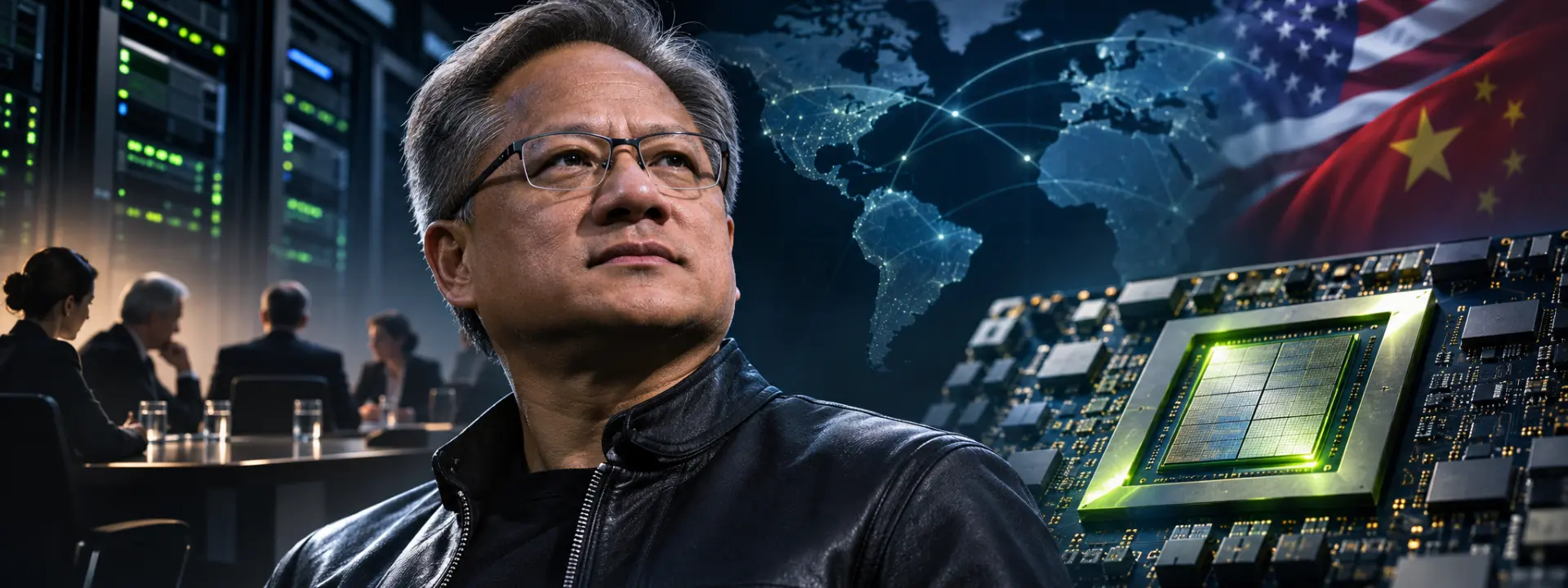
The founder of AI’s most strategically important company left his post overnight, brought down by a scandal involving an alleged affair with a woman suspected of espionage. Behind the scandal lies a much broader lesson: when a technology becomes strategic, those who lead it become targets.
On November 12, 2026, Nvidia issued a brief statement. Jensen Huang, the group’s cofounder and leader for thirty-three years, is stepping down as CEO and leaving the board of directors with immediate effect. Chief Financial Officer Colette Kress is taking over on an interim basis. Harvey C. Jones becomes the first chairman of the board in the company’s history. There is no transition period.
For the man in the leather jacket, who became the face of artificial intelligence in just a few years, the fall is as abrupt as the rise was spectacular.
What happened
For several weeks, the New York Times had been publishing a series of investigations into the relationship between Jensen Huang and a Chinese businesswoman, Alice Huang—no relation. A former executive at Megaspeed, a Singapore-based company and one of the largest buyers of Nvidia chips in Southeast Asia, she is suspected by US intelligence services of having been recruited by Beijing to approach Nvidia’s chief, and of having helped channel advanced chips into China. Beijing denies the allegations and calls them slander. Jensen Huang, for his part, acknowledged an extramarital affair. Other alleged relationships were subsequently mentioned.
The board of directors initially opened an independent investigation, entrusted to a former federal prosecutor, stating that it had no evidence indicating that company secrets or US national security had been compromised. A few days later, it accepted the resignation.
Since then, the affair has continued to take new turns. Donald Trump reportedly called Jensen Huang to encourage him to fight. Some employees are calling for his return, and Huang himself said he would be “honored” to return. The board closed the door on November 17, during the earnings presentation.
At this stage, nothing has been adjudicated. It is essential to stick to established facts and let the investigation do its work. But the affair already speaks volumes.
The chip is no longer a product; it is a matter of strategic power
For decades, a semiconductor was one component among many, bought from a catalog. Those days are over. Nvidia’s graphics processors have become the most coveted resource in the AI race between the United States and China. Washington restricts exports of the most advanced chips; Beijing seeks to obtain them by every possible means.
In this battle, the flows pass through intermediaries, third countries and providers renting out computing capacity. Megaspeed’s profile perfectly illustrates this gray area: a legitimate customer, a major buyer—and, perhaps, a gateway.
When a product becomes strategic, everything around it does too: its factories, its trade routes, its customers. And its executives.
The human link
Export controls, licenses and audits target goods. Espionage targets people. Trade shows, conferences, dinners after major events in Taipei: it is in these informal moments that relationships form, trust takes hold and doors open. This is precisely the terrain on which the alleged operation is said to have been conducted.
The best technical protection is useless if trust provides the route in.
The lesson is not just for Silicon Valley’s giants. Any company with rare expertise—an aerospace subcontractor, a machinery manufacturer, a small or medium-sized defense or electronics company—is exposed to the same mechanisms on a different scale: the overly helpful “partner,” the intermediary who asks a lot of questions, the contact who always appears at the right moment. Vigilance in relationships is part of corporate security.
The paradox: the man leaves, the dependence remains
The most striking point lies elsewhere. Five days after the resignation, Nvidia reported better-than-expected results: revenue that more than doubled year on year, and raised guidance. The stock had fallen sharply since the beginning of October, but customers had canceled nothing.
Why? Because no one can do without these chips today. Cloud giants, AI laboratories and governments themselves depend on this supplier. Nvidia has lost its public face, not its power.
One question remains that markets will not be able to ignore for long. Even before the announcement, analysts had pointed out that Jensen Huang had structured the company around himself, without a genuine team ready to take over. This is “key person” risk, familiar to thousands of family businesses and small and medium-sized enterprises: when everything rests on one person, an illness, a mistake or a scandal is enough to shake the whole structure.
The key takeaways
This affair is not a celebrity gossip story. It is a reminder of three realities:
- A strategic technology turns its leaders into targets. Security does not stop at servers and patents.
- Global dependence on AI chips is such that a scandal at the top does not shake demand. Power resides in the infrastructure, not in the man.
- A company that rests on a single person is vulnerable, whatever its size.
Technology wars are often invisible. This one has just surfaced.
The facts reported here are based on Nvidia’s statements and on reporting published by the international press as of November 19, 2026. The espionage allegations have not been the subject of any court ruling and are disputed by Beijing.
Sources and references
Read also
Nvidia: the day the board opened an investigation into its founderStephane Salomon — Auteur de La Guerre invisible et de L’Exigence allemande