ANALYSIS · ARTIFICIAL INTELLIGENCE · SEMICONDUCTORS
Nvidia: the day the board opened an investigation into its founder
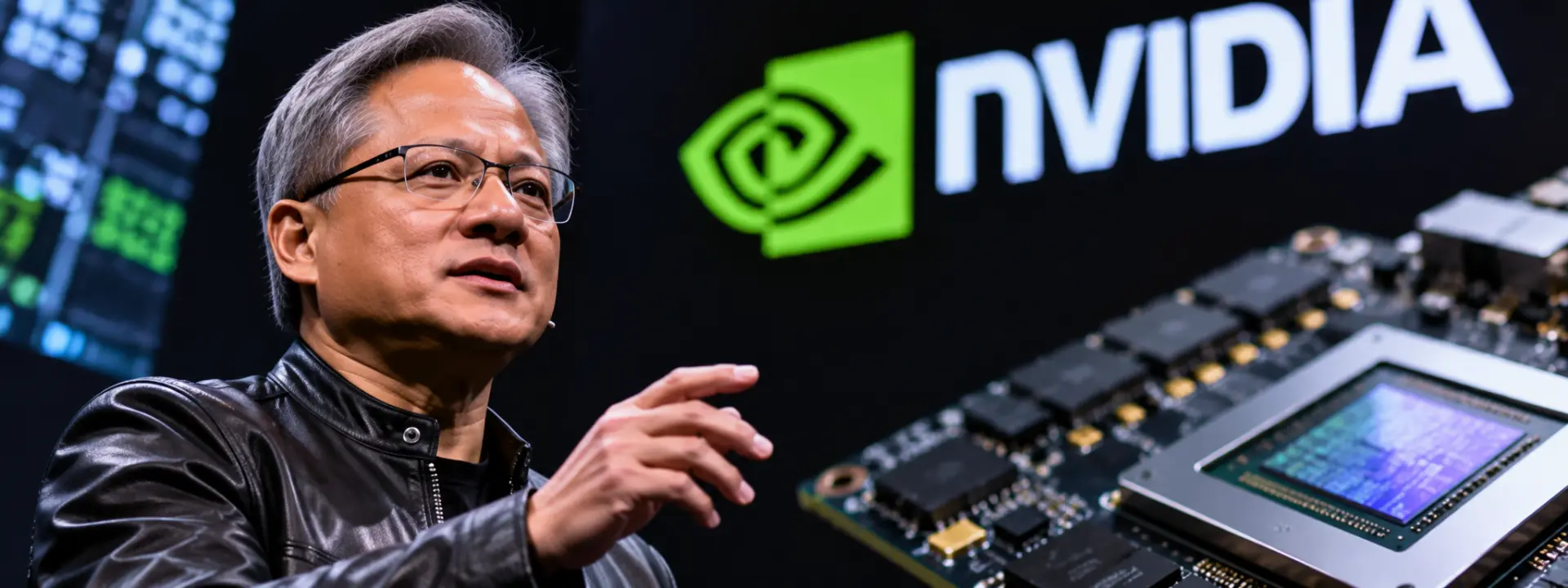
By announcing an independent investigation into Jensen Huang, Nvidia acknowledged that suspicions of espionage could reach the very top of the most strategically important company in artificial intelligence. Beyond the man himself, the fragility of controls on AI chips is being laid bare.
On Sunday, November 8, Nvidia’s board of directors issued a brief statement. It is opening an independent investigation following press reports that its founder and CEO, Jensen Huang, may have been targeted by a foreign intelligence operation. A committee of independent directors, assisted by outside lawyers, will oversee it.
That same day, in a message to employees, Jensen Huang acknowledged an extramarital affair, apologized to his family, his teams and shareholders, and announced that he would cooperate fully.
For a company that has made mastery and control its hallmark, this is a seismic shock.
What the statement says, and what it does not
The board weighed every word. It says that, at this stage, it has no reason to believe that Nvidia’s confidential information or US national security has been compromised. It expresses confidence in Jensen Huang and his management team. The CEO remains in his role during the investigation.
But a board that has confidence does not open an investigation. The mere fact that it announced one publicly shows that the issue extends beyond an executive’s private life. Two days later, the independent directors entrusted the case to a former federal prosecutor from New York and one of Wall Street’s most respected corporate law firms. Resources like these are not mobilized over a romantic affair.
At the heart of the case is a Chinese businesswoman, Alice Huang—no relation to Jensen Huang—whom the New York Times describes as having been recruited by Chinese intelligence services. Beijing denies the allegation and calls it slander. Nothing has been proved, and that must be emphasized. But the company with which she is associated has long been of interest to investigators.
Megaspeed, the weak link in the controls
Alice Huang was an executive at Megaspeed, a computing company based in Singapore that became the largest buyer of Nvidia chips in Southeast Asia in a very short time. Since 2025, Singapore’s authorities have been investigating several companies suspected of having shipped servers out to Malaysia without their entering the local market. US authorities are seeking to establish whether some of these chips ended up in China despite the ban. Megaspeed denies any wrongdoing, and Nvidia says it has no evidence that its chips were diverted.
Whatever the outcome, the mechanism is familiar. Washington bans sales of the most advanced chips to China. Chinese demand, however, does not disappear. It shifts: to third countries, shell companies and providers renting out computing capacity. A server purchased for a data center in Southeast Asia can be used remotely from Shanghai, or change hands several times before reaching its destination.
That is the limitation of any export control: it monitors boxes, not how their contents are used. And it relies on a chain of trust—manufacturer, distributor, integrator, end customer—in which any link can break.
Governance put to the test
Nvidia is a founder-led company. For thirty-three years, everything has revolved around Jensen Huang: the vision, major technological decisions, and relationships with customers, governments and markets. That is what made it strong. It is also what makes it vulnerable.
When suspicion falls on the founder himself, the board of directors finds itself in the most uncomfortable position imaginable: investigating the person who built the company without breaking the machine he runs. Too much caution, and the board looks indulgent. Too much firmness, and it risks destabilizing a company on which a large part of the global AI economy depends.
Markets reacted immediately: the stock fell as soon as trading opened on Monday. And according to the Wall Street Journal, the board is reportedly already considering far more consequential decisions.
What is at stake now
The coming days will be decisive. A House of Representatives committee focused on China has asked to be kept informed. Nvidia is due to release its quarterly results on November 17. And the internal investigation is only just beginning.
One thing is already clear. For years, the battle over chips has been told in terms of factories, patents and trade restrictions. The Nvidia affair is a reminder that it is also fought elsewhere: through relationships, intermediaries and the gray areas of global trade. The strictest rules are only as good as the people responsible for following them.
The facts reported here are based on the statement from Nvidia’s board of directors and on reporting published by the international press as of November 12, 2026. The espionage allegations have not been the subject of any court ruling and are disputed by Beijing.
Sources and references
Read also
Offices Empty Out: AI Takes Aim at White-Collar JobsStephane Salomon — Auteur de La Guerre invisible et de L’Exigence allemande