REPORT · ROBOTICS · ARTIFICIAL INTELLIGENCE
India’s hands: the workers teaching robots their trade
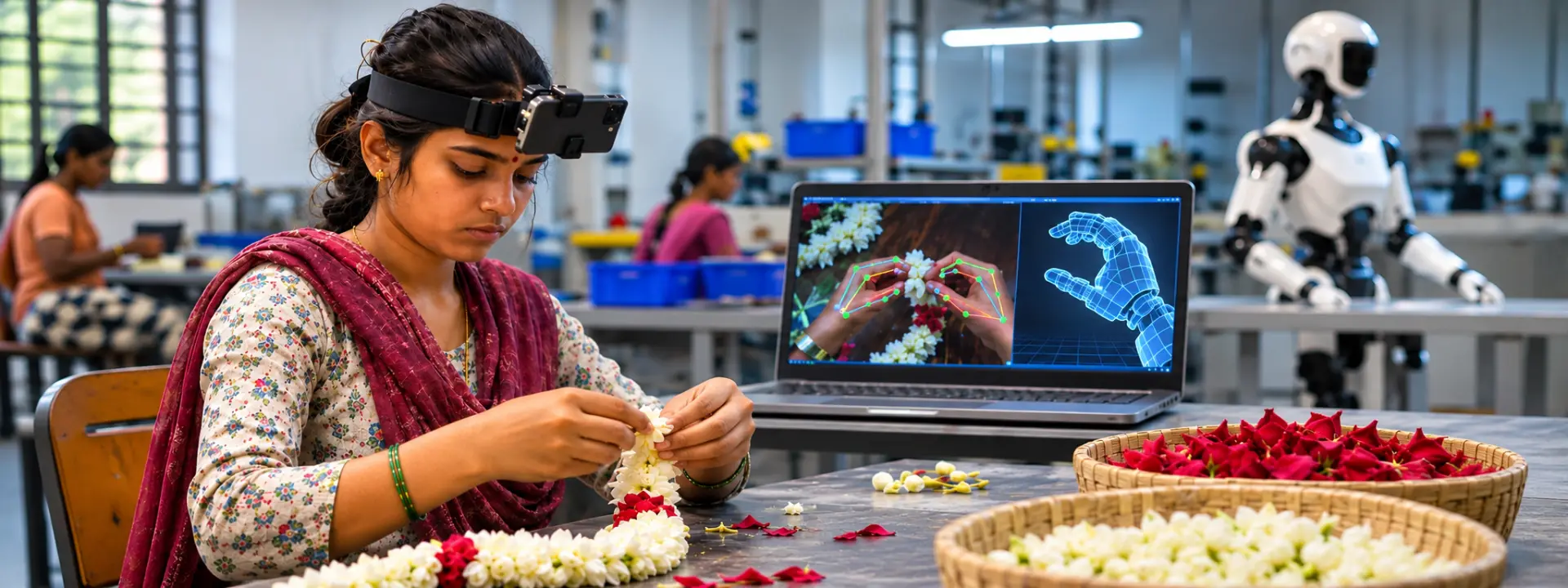
With cameras on their foreheads, they film their every move for a few euros an hour. Their videos are sent to the laboratories building tomorrow’s humanoid robots — the very machines that could one day take their place.
“The camera has to be straight to film my work properly.”
The words belong to a young worker in southern India, interviewed by Franceinfo. For five months, several days a week, she has worked with a camera fixed to her head. She is not filming a landscape or a face. She is filming her hands.
A few hundred kilometres away, in a small village in Tamil Nadu, twenty-five-year-old Nagireddy Sriramyachandra puts on a headband each day and attaches her mobile phone to it. Then she gets to work: cutting mangoes, folding laundry, making coffee. Utterly ordinary actions. And that is precisely what makes them valuable.
At the offices of Objectways, a data company based in the Karur district, other employees stack coloured blocks or fold towels in a mock bathroom. In New Delhi, more than two hundred homemakers film themselves cooking for another company, Manudata. A twenty-one-year-old engineer says she produces up to ninety videos a day. Bricklayers, barbers, flower garland makers, textile workers: the list keeps growing.
They are all doing the same thing. They are teaching machines their trade.
A few euros in pay
The pay is modest. At Objectways, it amounts to 250 rupees per hour of recorded video, or a little over two euros. At Manudata, the women earn a little under two euros an hour. For many, in a country where hundreds of millions of people make a living in the informal economy, it is a welcome supplementary income.
For those buying the footage, it is a strategic resource obtained at a bargain price.
These videos do not stay in India. Once filmed, they are segmented, annotated movement by movement, then resold. Most go to the big American technology companies racing to develop humanoid robots. Their names are almost never disclosed. Data collection companies refer only to “multinational” clients, sometimes among the world’s largest companies.
A single factory can produce up to a thousand hours of video a day. Manudata collects six hundred. And this is only the beginning.
The problem AI had not solved
To understand why such ordinary actions are worth money, it helps to look at how artificial intelligence works.
Models that write, translate or reason have been trained on an abundant resource: billions of pages of text available on the internet. Robots, however, face a much more tangible obstacle. To learn how to pick up a part, turn it, put it down, fold a piece of fabric or put an object away, they need examples of human actions. Millions of examples. Yet no one has ever filmed millions of hours of hands at work from eye level.
“Robots don’t know how to put a towel away in a cupboard”: the observation, reported by Franceinfo, sums up the challenge. What is trivial for a child remains extremely difficult for a machine.
Hence the use of so-called “egocentric” footage, shot from the perspective of the person performing the task, just as a robot would see it. Some companies go further. The start-up Human Archive, backed by Silicon Valley investors and having raised more than eight million dollars, equips workers with visor headsets to film in three dimensions and wrist cameras to capture finger movements. One of its founders states it plainly: the technology is intended to become basic infrastructure for the automation of manual labour.
The race to a billion hours
The scale of the need is staggering. According to the head of Labellerr.ai, an Indian company specialising in training data, the industry has already collected around fifty million hours of video in a year and a half. It would need at least a billion.
India has everything this new market is looking for: a vast workforce, an extraordinary range of manual trades and some of the lowest costs in the world. The country had already established itself as a leader in data annotation for artificial intelligence. It is now becoming the world’s largest source of recorded human actions.
The pace is accelerating. The first deployments of humanoid robots are scheduled for the end of 2027. Some projections put the number of these machines in service at more than a billion by 2050, mainly in industry and commerce.
Training your own replacement
The paradox is lost on no one, least of all the workers themselves.
“We’ll end up losing our jobs,” one worker tells TF1. Ponni, a flower garland maker, is already thinking about her children: the next generation, who might have done the same work as her, “will have a problem”. Nagireddy Sriramyachandra chooses irony instead: one day, she says, she may have a robot of her own.
Not everyone shares this concern. One textile factory owner believes robots will not do exactly the same work, but could help workers become faster and more precise. The two views coexist. The future will tell which one prevails.
Meanwhile, the questions are mounting. Do workers really know what their footage is used for? Who owns it? What will become of this data in ten years? Press investigations have shown that workers at a large textile workshop in Gurugram, near New Delhi, wore these cameras, although it was not always clear what had been explained to them. The Indian government’s own think tank notes that the country has hundreds of millions of informal workers, and that debates about AI almost always overlook them.
What this changes for us
To a European reader, all this might seem remote. It is not.
For decades, industrial know-how was passed from person to person: the experienced operator training the newcomer, the action repeated hundreds of times, the skill found in no manual. This invisible asset often makes the difference between two factories equipped with the same machines.
That asset is changing in nature. It is becoming data that can be filmed, stored, sold and exported. Those who amassed the most text gained an advantage in today’s artificial intelligence. Those who amass the largest libraries of human actions will gain an advantage in tomorrow’s robotics.
The question, then, is no longer simply whether robots will replace workers. It is who will own the know-how they have acquired — and who will have sold it for two euros an hour.
The facts reported here are based on information published by the international press as of 18 November 2026. The figures cited are indicative.
Sources and references
Read also
Nvidia without Jensen Huang: the flaw was not in the chipStephane Salomon — Auteur de La Guerre invisible et de L’Exigence allemande