REPORT · INDUSTRY · ROBOTICS
Factories in the Dark: How China Is Inventing the Workerless Workshop
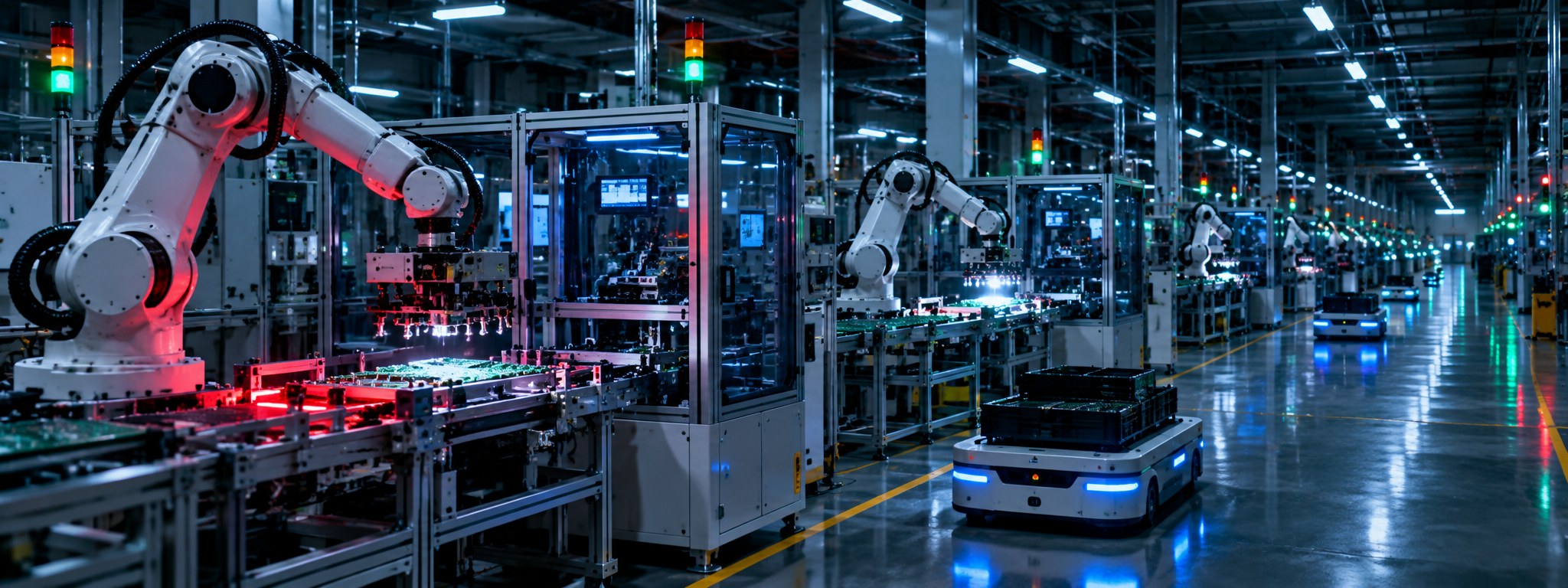
Across China, factories operate day and night without lights—because robots simply don't need them. What once sounded like science fiction has turned into a national industrial strategy. And Europe would be wrong to think it still has time.
On the shop floor, there is hardly a soul. Assembly lines run uninterrupted. Automated guided vehicles ferry parts back and forth. Faint indicator lights merely mark the areas where machines are at work. On the control screen, a red alert indicates that a robot has paused for a few brief moments.
This is Zeekr, a Chinese electric vehicle manufacturer, inside a plant filmed by Franceinfo. The facility operates with 885 robots and roughly one hundred employees. It can churn out up to 1,200 vehicles a day.
Human beings have not vanished entirely. They inspect welds made by robots and check final finishes prior to delivery—a stage machines have not yet mastered. One worker, an automotive veteran of some twenty years, sums up his new role: “Our job is simply to help the robots.”
The Factory That Keeps the Lights Off
In the English-speaking world, they are known as “dark factories.” Since robots require neither lighting nor heating, the power can simply be cut.
The most striking example lies in Changping, on the outskirts of Beijing. There, Chinese smartphone giant Xiaomi runs a facility operating 24 hours a day in total darkness, with no workers on the assembly lines. A phone rolls off the line every few seconds. The brains behind the operation is an artificial intelligence system developed in-house: it monitors machinery in real time, anticipates breakdowns, and adjusts production without human intervention.
A State-Driven Policy
These facilities are not isolated showcases. They are the deliberate outcome of an overt strategy.
In 2024, China deployed 295,000 industrial robots—more than the rest of the world combined. Its operational stock now exceeds two million machines, accounting for nearly half of the global total. Over half of the robots installed in its factories are now made in China. The country also holds two-thirds of the world's robotics patents.
Beijing has even coined a slogan: “Replace men with machines.” Faced with rising wages, an aging population, and labor shortages, the state is providing subsidies. Companies can recoup up to 20% of their spending on robotics.
The results are tangible. At Changying Precision, an electronics subcontractor, output per worker surged from 8,000 to 21,000 parts per month, while the defect rate plummeted from 25% to 5%. According to McKinsey, one-third of Chinese factories could be fully automated by 2030.
Where Does Europe Stand?
Europe is not as far behind as one might assume. Proportionate to its workforce, German industry still counts nearly three times as many robots as Chinese industry. South Korea performs even better. Moreover, European manufacturers' margins remain, for now, more resilient than those of their Chinese rivals, who are locked in a fierce price war.
Yet the momentum is fundamentally different. China is automating at a pace and scale unseen anywhere else. It is no longer merely looking to cut production costs: it aims to decouple manufacturing from human labor, thereby gaining the ability to produce anywhere, anytime, in unlimited quantities.
This shift will only accelerate with the arrival of humanoid robots capable of manipulating objects like a human hand. These are the very machines currently being trained by recording the movements of thousands of factory workers in India.
For European manufacturers, the question is no longer whether to automate. It is whether they can move fast enough to stay in the race, and whether they can retain the human skills that still make all the difference today: inspection, finishing, and judgment.
At the Zeekr plant, human hands still check that final weld. But for how much longer?
The facts reported here are based on information published by the press and industry studies as of November 2026. The figures cited are provided for informational purposes.
Sources and references
Read also
Data Centers: When Artificial Intelligence Takes Root in FarmlandStephane Salomon — Auteur de La Guerre invisible et de L’Exigence allemande